Insights
Expert analysis and real-world perspectives to guide smarter performance decisions.

We’re happy to answer your questions
The regulatory environment for worker classification in the United States has never been more complex or more consequential. Three forces are converging simultaneously that make this the most dangerous year for enterprises relying on independent contractors.
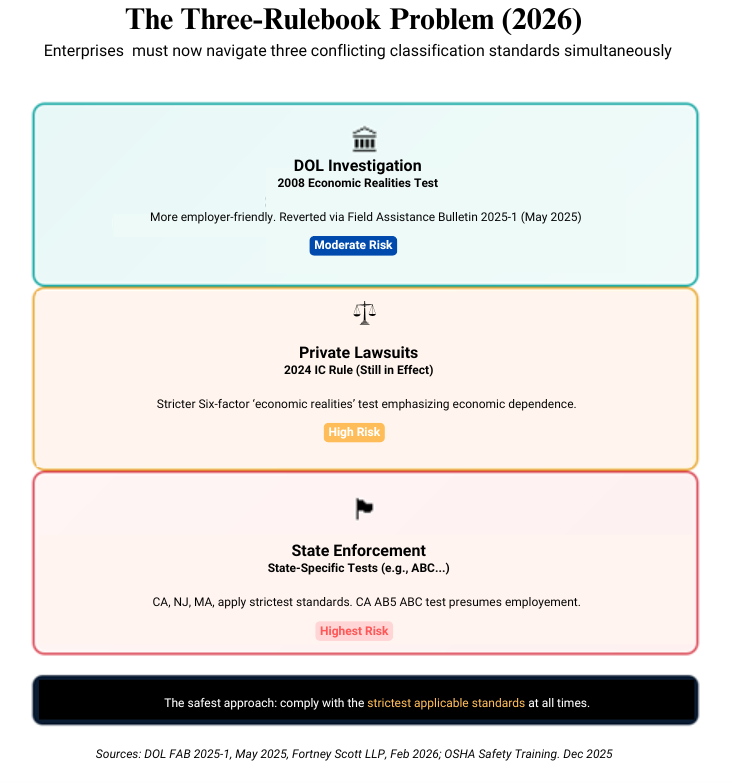
In May 2025, the U.S. Department of Labor issued Field Assistance Bulletin 2025-1, instructing investigators to stop applying the Biden-era 2024 independent contractor rule under the Fair Labor Standards Act. Federal investigators now apply the 2008 guidance, which uses a more employer-friendly economic realities test. But the 2024 rule remains legally enforceable in private litigation. And states like California, New Jersey, and Massachusetts continue to enforce their own, often stricter, classification standards.
Sources: National Employment Law Project, 2024 update; Economic Policy Institute, January 2025.
This means enterprises now face three simultaneous and conflicting standards: DOL investigations use the 2008 test; private lawsuits use the 2024 economic realities test; and state enforcement uses state-specific tests that are often the most aggressive. The result is regulatory limbo, where the safest approach is to comply with the strictest applicable standard at all times.
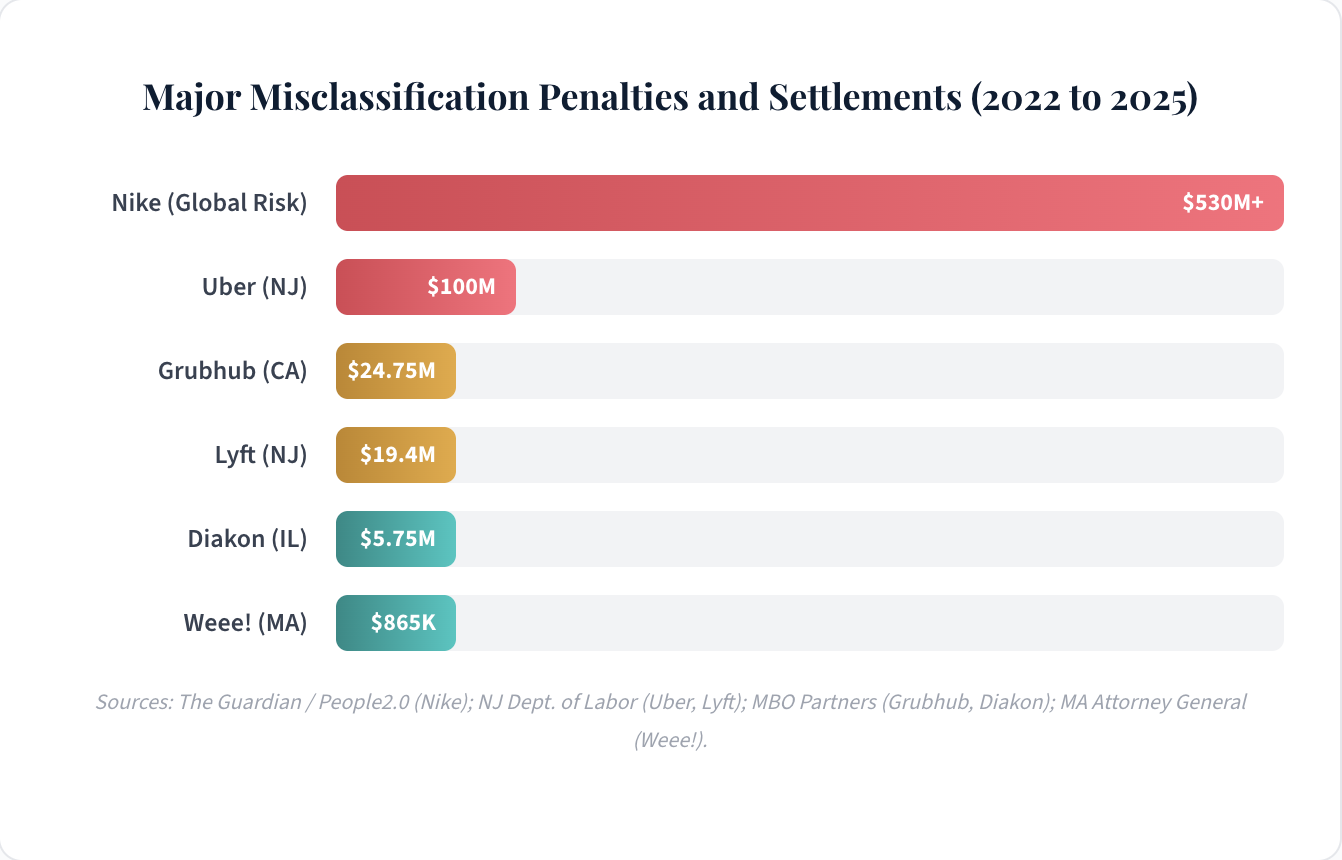
California can impose penalties up to $25,000 per misclassified worker. New Jersey's penalty structure includes up to 5% of the worker's gross earnings, plus $250 per worker for first violations and $1,000 per worker for subsequent violations, plus additional damages of up to 200% of wages owed. Minnesota enacted penalties of up to $10,000 per misclassification. Most states are increasing their enforcement budgets for 2026.
Sources: Multiplier, Jan 2026; Miller Shah LLP, Jan 2026; Minnesota Attorney General's Office.
For North American enterprises with operations or outsourcing relationships in India, classification risk is growing. India's Code on Social Security 2020 recognized gig workers for the first time in Indian law, and Rajasthan passed India's first state-level gig worker protection act in 2023. Indian courts have historically favored employees in classification disputes, and companies found misclassifying workers face back-dated provident fund, ESI, and gratuity contributions, along with penalties and potential criminal liability for managers. With India's gig workforce projected to reach 23.5 million by 2029-30 (NITI Aayog), enforcement scrutiny is intensifying.
Sources: Deel, Sept 2025; Anantam IAS / NITI Aayog projections; Rajasthan Platform-Based Gig Workers Act, 2023.
Misclassification rarely happens because someone decided to break the law. It happens because the systems, processes, and ownership structures of contingent workforce programs were never designed to catch it. Here are the five most common blind spots.
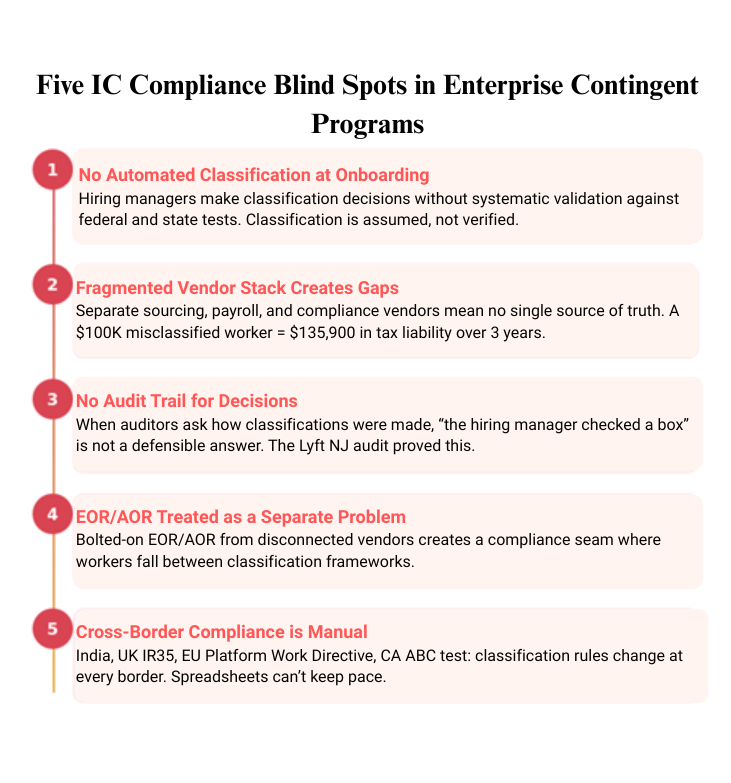
Most enterprises onboard independent contractors with a signed agreement and a purchase order. The classification decision itself is made by a hiring manager, not validated by a compliance engine. There is no systematic evaluation of behavioral control, financial control, or relationship factors against the applicable federal and state tests.
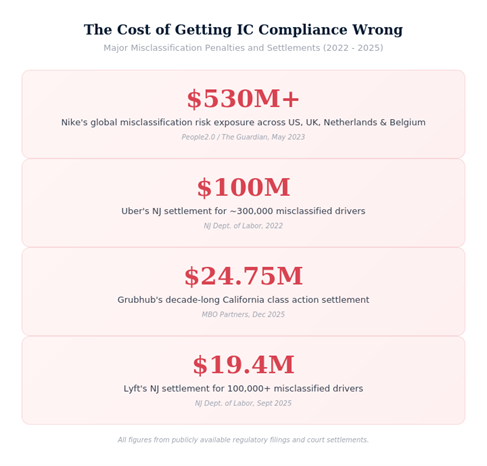
When sourcing, onboarding, payroll, and compliance live in separate systems, there is no single source of truth for worker status. According to Plante Moran, misclassifying a single $100,000-per-year worker can generate cumulative employment tax liabilities of $135,900 over three years, excluding interest and penalties.
Source: Plante Moran, 'Navigating Worker Classification,' Nov 2025.
When a DOL investigator or state auditor examines your contractor relationships, they will ask how classification decisions were made, who made them, and what evidence supported them. The Lyft audit in New Jersey was triggered when drivers applied for unemployment benefits. The evidence gap was immediate and costly.
Many enterprises bolt on Employer of Record and Agent of Record services from separate vendors, disconnected from their direct sourcing and VMS systems. This creates a compliance seam where workers can fall between the cracks.
For enterprises with global contingent workforce operations, classification rules change at every border. India's tests differ from UK IR35, which differs from the EU Platform Work Directive, which differs from California's ABC test.
Misclassification is not just a penalty. It is a cascade of financial exposures that compound over time.
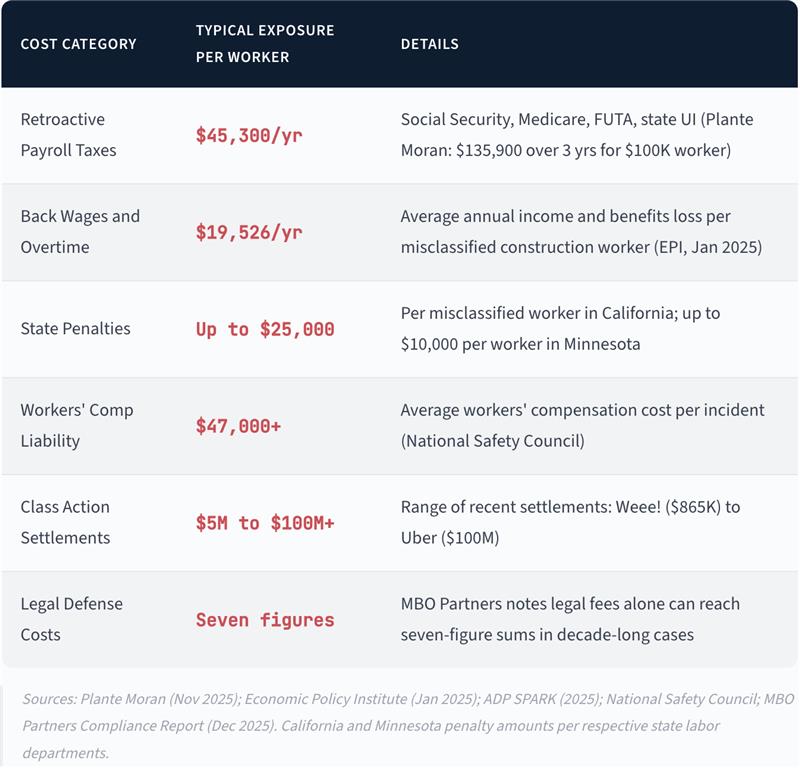
"Misclassification imposes a financial toll on both good actor employers and misclassified workers, who lose critical rights such as minimum wage, overtime pay, workers' compensation coverage, unemployment insurance, earned sick leave, family leave, and more."
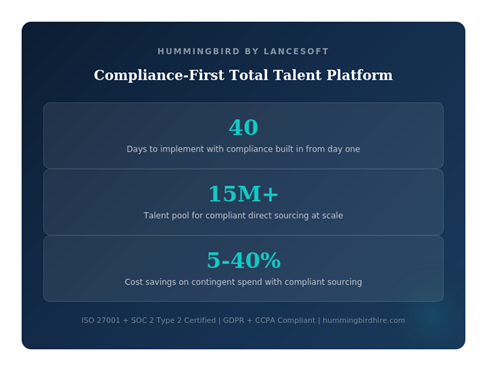
Hummingbird is the AI-powered Total Talent Platform built by LanceSoft Inc. that unifies Direct Sourcing, Talent Intelligence, VMS, Compliance, Payroll, EOR, and AOR in a single ecosystem. It was built by practitioners who ran contingent workforce programs before building the technology. That practitioner DNA is why compliance is not a module added to Hummingbird. It is woven into the architecture.
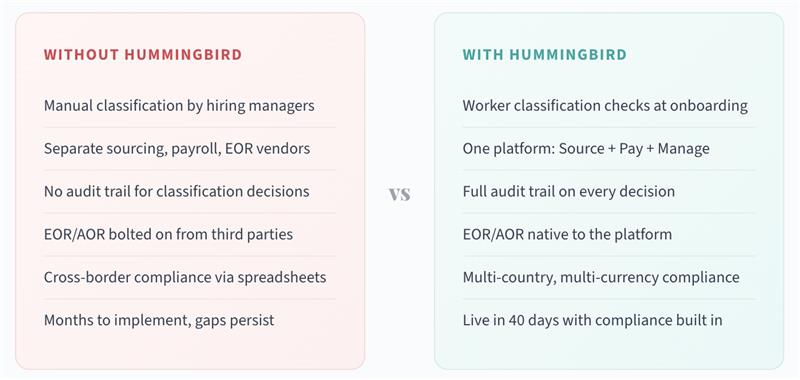
Hummingbird's onboarding workflow includes worker classification and compliance checks as a native step. Right-to-work validation, contract compliance, and employment agreement generation are built into the process, not layered on top. Every classification decision creates a documented audit trail that stands up to regulatory scrutiny.
Hummingbird is the only direct sourcing platform that has Employer of Record (EOR) and Agent of Record (AOR) capabilities built natively into the same platform, alongside multi-country, multi-currency payroll, timesheet management, and worker compliance. The EOR/AOR module is designed to reinforce, not blur, the employer-of-record structure.
When sourcing, screening, onboarding, payroll, and compliance live in one system, there is no gap for classification drift. Hummingbird provides a unified view of all workforce types including direct sourced talent, internal FTEs, contingent workers, and EOR-managed employees.
Hummingbird's AI matching shows the 'why' behind every score, not just a number. Human-in-the-loop oversight at every automated stage supports compliance with NYC Local Law 144, EEOC AI hiring guidance, and emerging AI regulations.
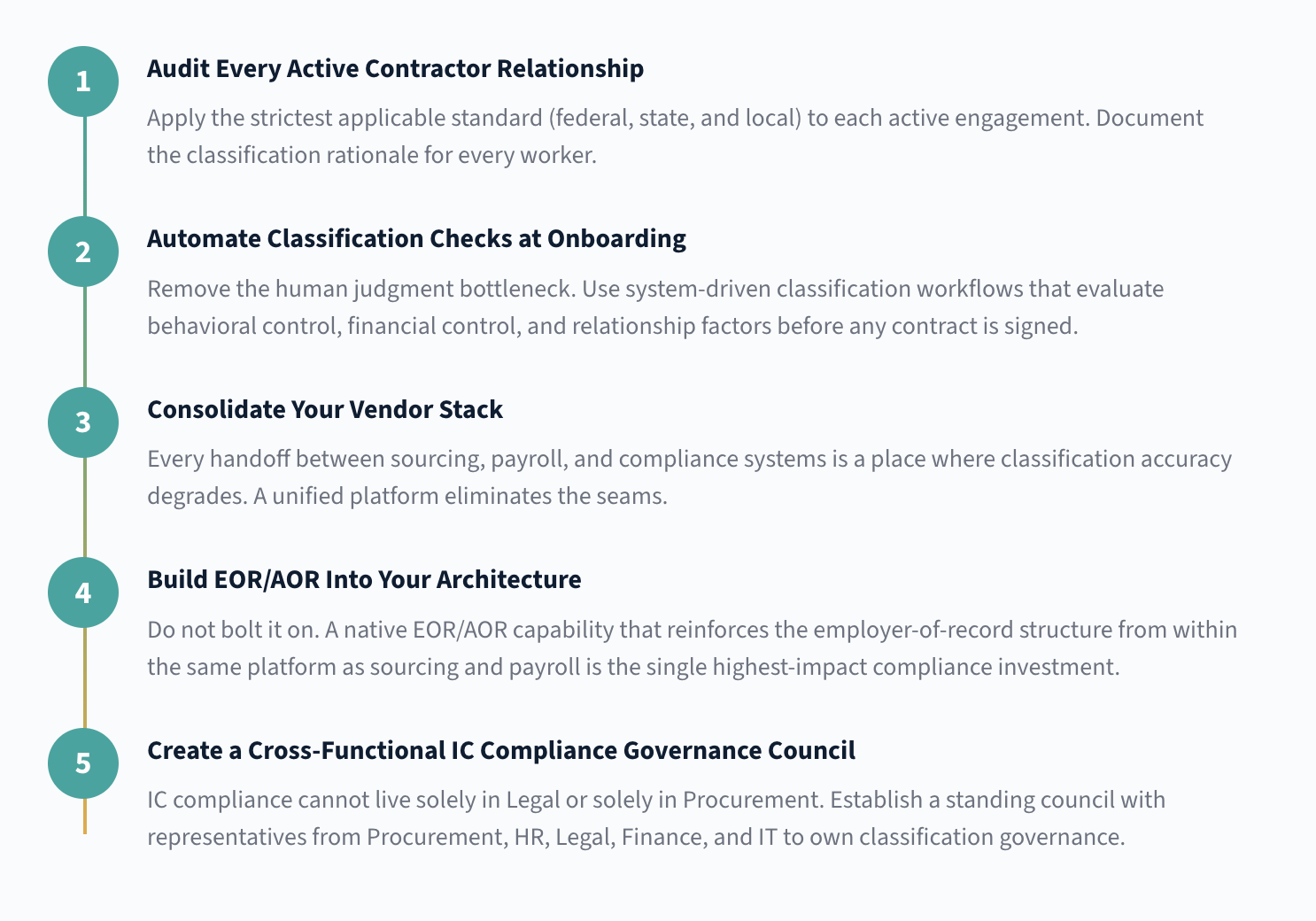
Whether you adopt Hummingbird or not, every enterprise engaging independent contractors should take these five steps immediately.
Book a complimentary pilot program for your organization. See how automated classification checks, native EOR/AOR, and unified workforce management work in your environment.
Hummingbird was not built in a lab. It was built inside contingent workforce programs, by practitioners who lived with the pain of fragmented vendors, manual compliance, and classification risk.

CEO, LanceSoft Inc.
Visionary behind Hummingbird's development as a practitioner-built platform for the enterprise workforce.

Global Chief Revenue Officer, Hummingbird
Leading the Entire Motion of Hummingbird.

Ex-Mastercard Procurement Leader
Bringing Fortune 500 procurement transformation experience.

Ex-Meta Procurement Leader
Deep expertise in scaled contingent workforce operations.
When Pratik Patel managed procurement at Mastercard and Keith Wulffraat led procurement at Meta, they experienced firsthand the compliance gaps that fragmented vendor stacks create. Their advisory involvement ensures Hummingbird is built with the operational reality of enterprise procurement at its core.
Connect with Puneet Grover, Global CRO of Hummingbird, on LinkedIn to discuss how your organization can close the IC compliance gap.
Connect on LinkedIn
Hummingbird
The AI-Powered Total Talent Platform by LanceSoft Inc.
This newsletter is for informational purposes only and does not constitute legal advice. Consult qualified legal counsel for classification decisions specific to your organization.
© 2026 Hummingbird. All rights reserved.